
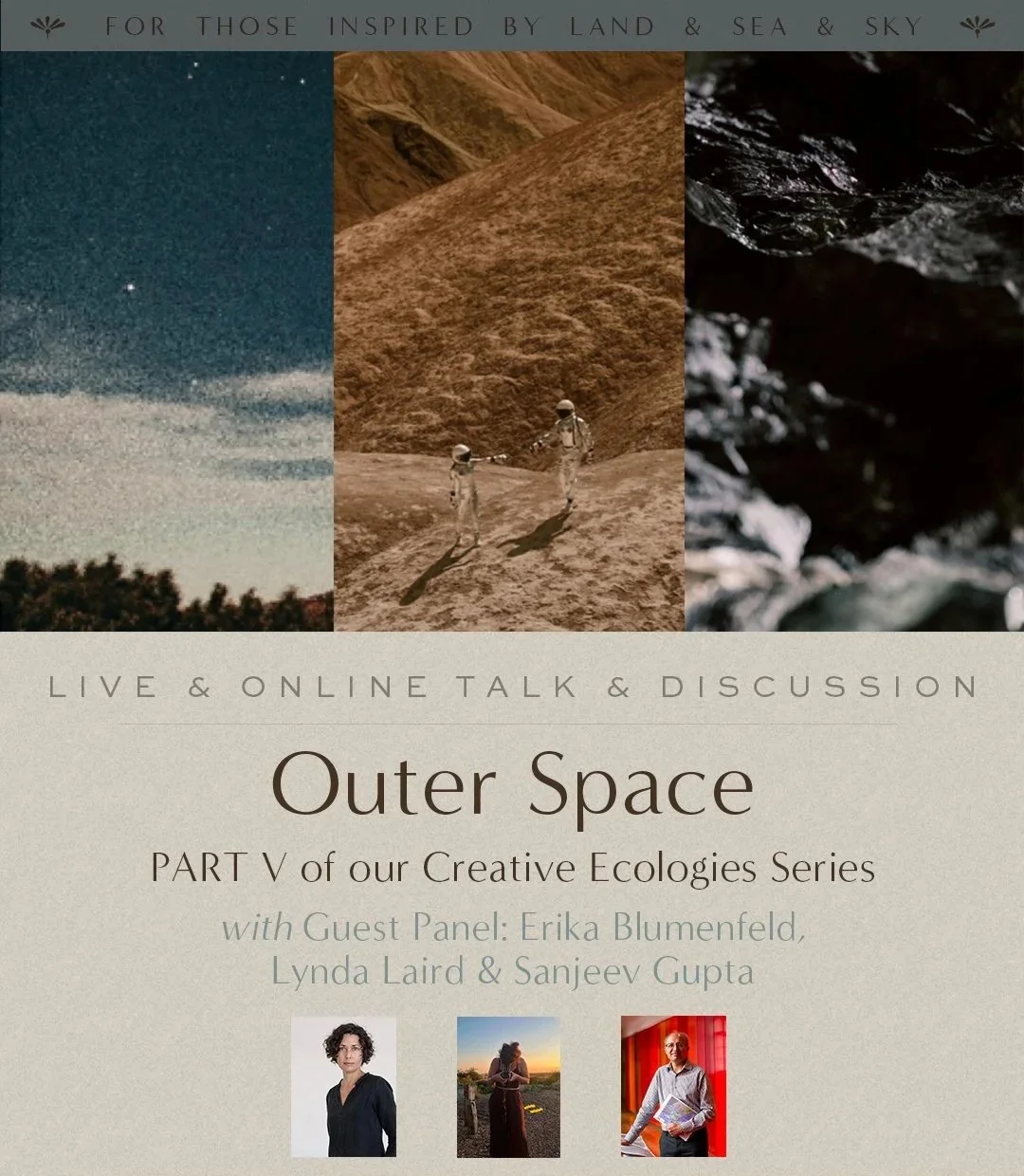

Today, most of humanity can picture the surface of Mars ~ its ochre plains, dust storms, and ancient riverbeds ~ despite fewer than 600 humans ever having travelled beyond Earth’s atmosphere. This speaks not only to our curiosity, but to the power of photography and data in shaping planetary consciousness. As telescopes, orbiters, and rovers beam images back across space, it is through the lens ~ both literal and conceptual ~ that the galaxy enters the human imagination.
At the heart of this conversation is the camera as a kind of black hole: a device that absorbs light and time, compresses reality, and returns a fragment that can be decoded, debated, and even dreamed from afar.
In this dialogue, we are joined by three remarkable voices whose work crosses the terrain between image, matter, and meaning:
Lynda Laird, Lynda Laird is a documentary photographic artist whose work interweaves research, archival material, photography, moving image and sound. Her practice is centered on exploring the materiality of landscapes, often employing camera-less techniques and integrating materials directly sourced from these environments to create images that physically embed traces of the landscapes' history and essence into the work.
Professor Sanjeev Gupta, planetary geologist and science team member on NASA’s Perseverance mission, whose work has been central to interpreting the Martian surface, decodes the sedimentary language of other worlds ~ transforming pixels into geological stories billions of years old.
Erika Blumenfeld, artist and Creative & Photography Lead for the Advanced Imaging & Visualization of Astromaterials (AIVA) at NASA, Erika bridges the poetic and the empirical. Her work translates scientific data, moon rocks, and light itself into visual language ~ engaging space not as a distant realm, but as part of Earth’s extended ecology.
Together, they invite us to consider: What does it mean to see a planet we’ve never touched? What truths ~ scientific, political, poetic ~ are embedded in the act of imaging space? And how do these images reshape our sense of Earth, time and the future?

Feedback from our Talks